Current article

How Health Centers Get RHTP Funding: A Guide to State Grant Windows
Est. reading time: 14 minutes
You cannot apply to CMS for RHTP money. That is the single most important thing to know about the $50 billion Rural Health Transformation Program, and it is the thing most health centers learn too late.
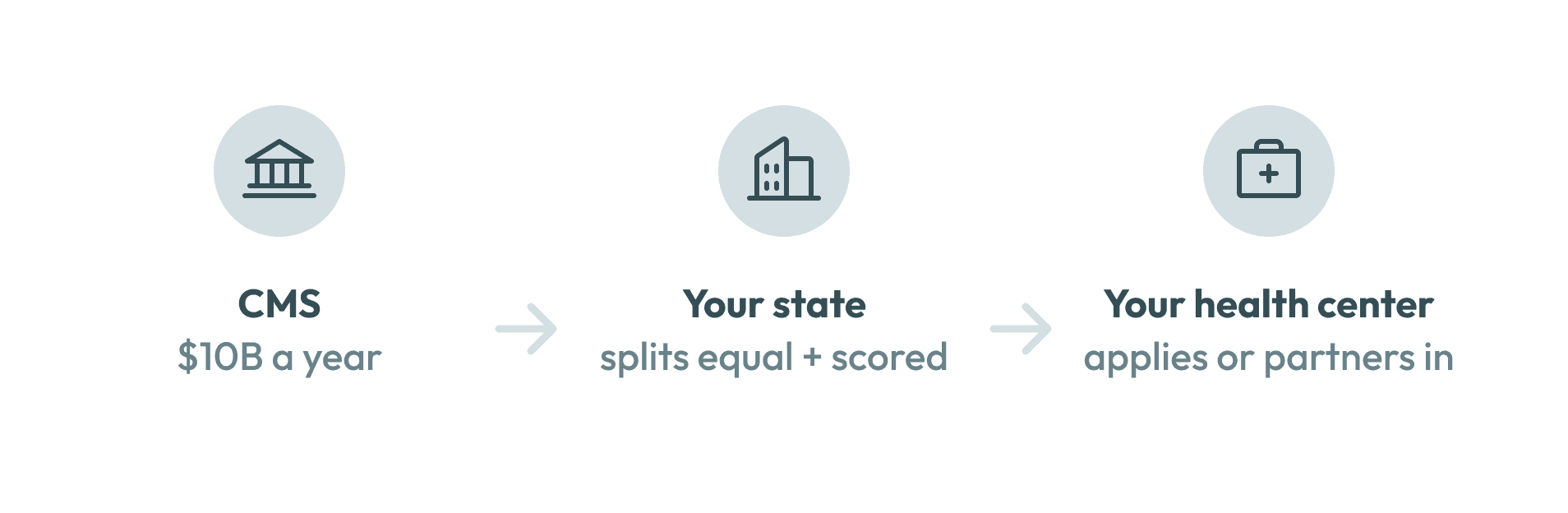
CMS funds states. States fund you.
Each year of the program, CMS releases an installment to all 50 states. There is no federal application portal for a health center to find, and no way to appeal directly to CMS for a share. Your state then runs its own grant programs, RFPs, and procurement processes to move that money out to hospitals, clinics, FQHCs, and other rural providers.
The application door is in your state capital.
A note on how fast this is moving. State RHTP programs are being designed, announced, opened, and closed on a rolling basis, with new opportunities posting somewhere nearly every week. The examples in this guide illustrate the shapes these programs take. They are not a current list, and several referenced here have already closed. Treat them as patterns to recognize, then go check what your own state has open right now. The section on where to look is the part to act on.
This guide covers how the money flows, what state processes tend to look like, where to find your state’s opportunities, and how to be ready before a window opens rather than after it closes.
The short version

CMS funds states, states fund you. $10 billion per year for five years, FY2026 through FY2030. States receive it, then re-distribute through their own grant and procurement processes.
Every state’s process is different. Some run competitive RFPs. Some work through third-party administrators. Some route funds through existing state agencies.
The windows are short. State opportunities have run anywhere from about two weeks to a couple of months from posting to deadline.
Future years are not guaranteed. Each year, CMS reviews state progress and sets the following year’s funding levels. Unspent funds can be returned to the Treasury and redistributed.
“Transformational” is the operative word. RHTP is built to fund structural change to how care gets delivered, not routine operating support.
How the money moves: CMS, then your state, then you
The Rural Health Transformation Program appropriates $50 billion across all 50 states from FY2026 through FY2030, administered by CMS in $10 billion annual installments. Congress created it in the One Big Beautiful Bill Act as an offset to the anticipated rural impact of that law’s Medicaid reductions.
Half of each year’s $10 billion is split evenly among all approved states. In the program’s first year, that meant $100 million per state regardless of size.
The other half is where it gets interesting, and where a common misconception needs correcting.
That second half is not distributed by pure formula. CMS steers it using two inputs. The first is a state’s rural score, which weights factors like rural population and rural facility share. The second is a discretionary “technical” score, which CMS assigns based on the quality of a state’s proposal and its willingness to adopt certain policy actions.
An analysis by the University of North Carolina’s Cecil G. Sheps Center isolated how much each state received from the technical score alone in the first year. The spread was wide: Alaska scored highest, while New Mexico had under 10% of its award tied to discretionary metrics.
This matters for a practical reason. Discretionary dollars can be re-pooled and reallocated between years. As Sheps Center director Mark Holmes observed, states should expect their amounts to shift year over year based on that redistribution. Your state’s allocation is not a fixed five-year number, which means the competitive environment inside your state can change between one funding round and the next.
The result of all this is enormous variation in what a state actually has to spend per rural resident. A KFF analysis of first-year awards found a nearly hundredfold spread, from roughly $66 per rural resident in Texas, which has the largest rural population in the country, to roughly $6,300 in Rhode Island. Ten states came in under $100 per rural resident. Eight came in over $500.
The strategic read holds regardless of the specific year’s numbers. In a high-population rural state, there is more total money and far more competition for it. In a small state, there is less money overall but a much thinner applicant pool. Both are worth knowing before you decide how much effort a given application deserves.
What a state grant window actually looks like
States do not hand RHTP dollars directly to every eligible rural provider. They move their allotment out through their own processes, and those processes vary more than most health centers expect.
Three recurring patterns are worth learning to recognize.
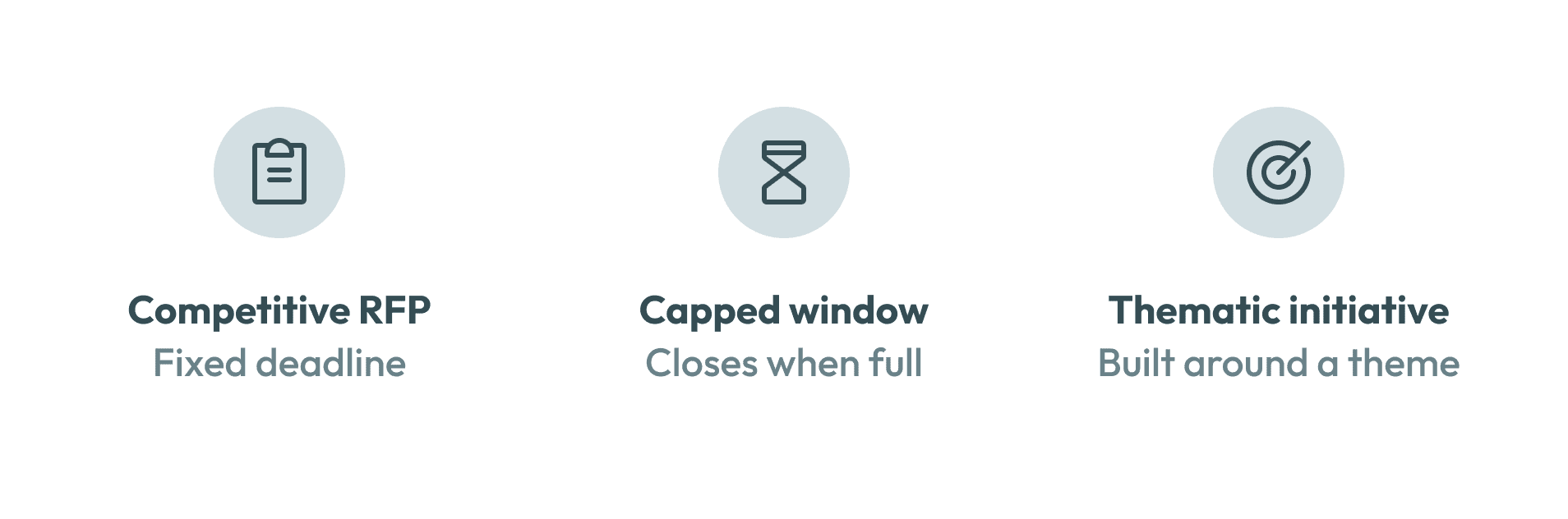
Competitive RFPs run by the state health department. Minnesota, for example, has distributed the bulk of its allotment as grants to rural and Critical Access hospitals, rural Tribal Nations, FQHCs, and rural CCBHCs and CMHCs. These look like traditional state grant competitions, with published scoring criteria and a fixed submission deadline. They tend to be the largest opportunities and the most competitive.
Narrow, capped, first-come opportunities. Pennsylvania posted a small pool of RHTP funding specifically for FQHCs and FQHC Look-Alikes to implement Certified Electronic Health Record Technology, capped per organization, and open only until the funding cap was met. That window ran eleven days. Opportunities in this shape are the easiest to miss and often the easiest to win, because the pool of organizations watching closely enough to catch them is small.
Large thematic initiatives. New York released tens of millions of dollars under a single named initiative focused on rural community health integration. Wisconsin ran a rural technology fund open to organizations operating FQHCs in rural and semi-rural communities. These are built around a theme the state committed to in its plan, and they reward applicants whose project already fits that theme rather than those trying to retrofit one.
The pattern worth internalizing: these are short, specific, and thematically constrained. A generic readiness posture does not help. Knowing your state’s stated priorities, and having a project already scoped against them, does.
Where to find your state’s opportunities
There is no single federal list. Finding your state’s windows takes deliberate, ongoing effort, and it is the highest-leverage administrative work available to a rural health center right now.
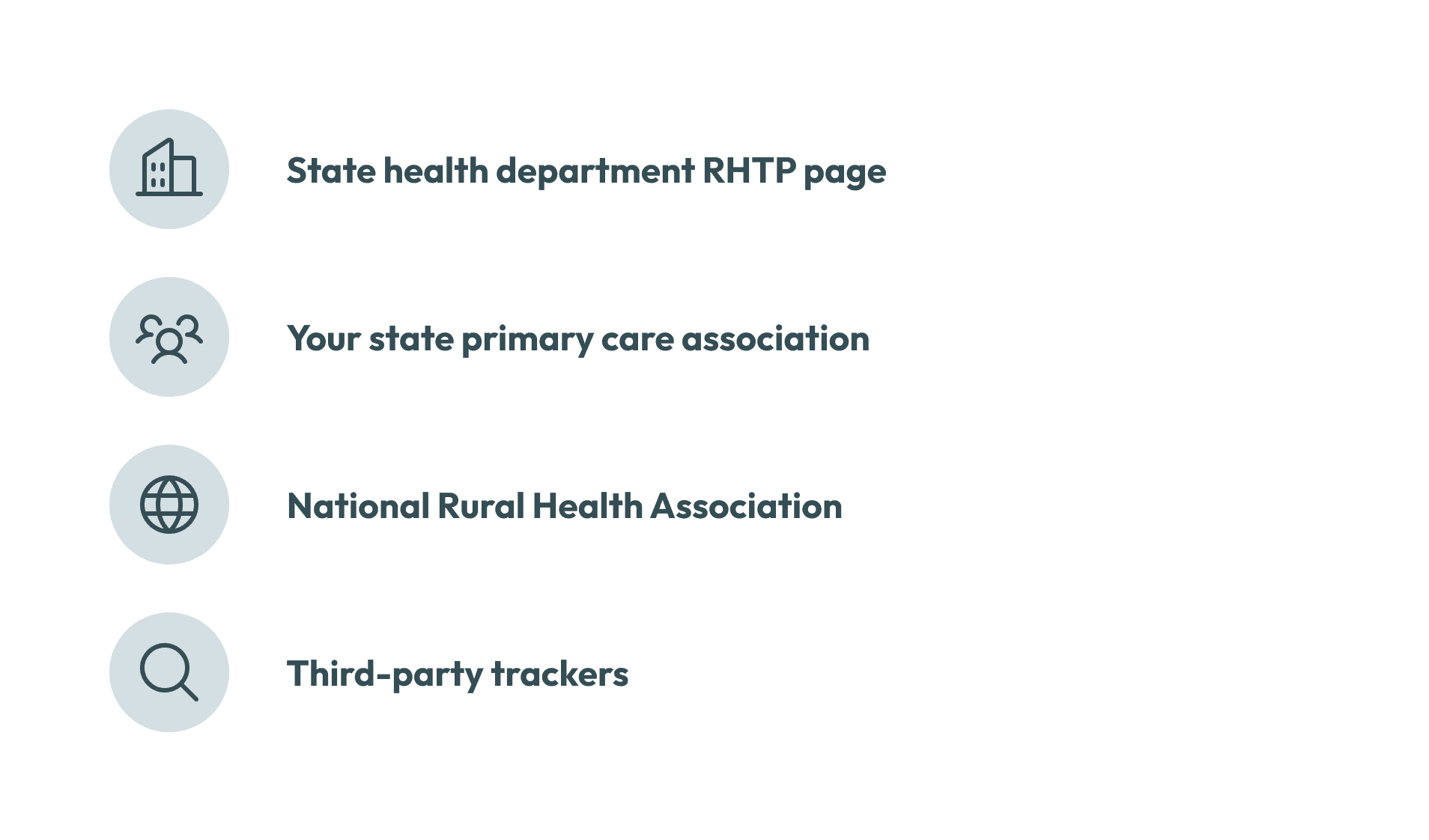
Check these four places, and check them on a schedule:
Your state health department’s RHTP page. Nearly every state has stood one up, and most post opportunities there first. Many offer email notification lists. Subscribe to every one you qualify for.
Your state primary care association. PCAs have generally been faster than state agencies at flagging FQHC-eligible opportunities to their members, and many provide application support.
The National Rural Health Association. NRHA’s Center for Rural Health Innovation maintains RHTP resources organized by state.
Third-party trackers. Several now maintain frequently updated views of where each state stands in its procurement process and what is currently open.
One organizational note matters more than it sounds: assign this to a named person. The health centers capturing RHTP dollars are the ones where somebody’s actual job includes checking these sources weekly. The ones missing windows are the ones where everyone assumed someone else was watching.
The annual cycle, and the pressure it creates
The program runs on a rhythm that repeats each year, and understanding it tells you when to expect activity.
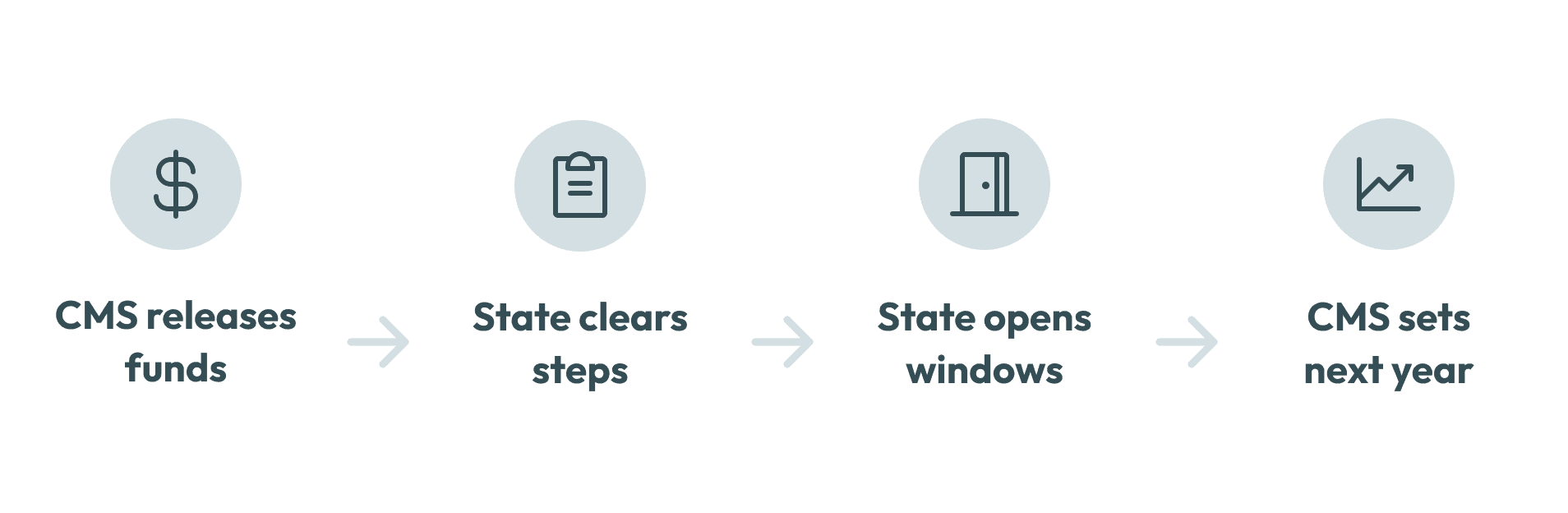
CMS releases that year’s installment. States must clear administrative steps, including submitting revised budgets, before they can draw funds down. That process consumes months, which compresses each year’s actual distribution into a shorter window than the calendar suggests. States then run their own opportunities against that compressed timeline. Later in the year, CMS reviews how states are performing and sets the following year’s funding levels.
Two consequences follow, and both persist across the life of the program.
The first is opportunity. States are evaluated partly on whether they can spend the money well and on schedule. That creates real pressure to move funds out the door and show results. A health center that shows up with a scoped, measurable project is easier for a state to say yes to than one that needs three months of hand-holding. States that are behind on distribution are especially motivated to find credible applicants quickly.
The second is risk. Unspent allotments can be returned to the Treasury and redistributed. Money your state does not move is money your region loses, and it does not come back later.
What RHTP will fund, and what it won’t
Each state’s approved plan describes how it will use funding across a defined set of priorities. Those priorities are consistent across states: improving access to care, improving health outcomes, prioritizing new technology for prevention and chronic disease management, building regional partnerships, growing the clinical workforce, and shoring up the long-term financial solvency of rural hospitals.
Two signals about what actually gets funded are worth reading closely.
First, technology is a near-universal theme. A KFF Health News review of state project abstracts found that a third of states want to improve electronic health records, and every single state mentioned telehealth. If your project has a technology component that improves access or care coordination, it is aligned with what states themselves committed to.
Second, and less comfortably: large vendors have noticed. Rural hospital leaders have described being flooded with outreach from for-profit companies wanting to partner on applications. Terry Scoggin, former interim CEO of the Texas Organization of Rural & Community Hospitals, said he was “blown away about how many for-profit companies reached out.” You are competing for reviewer attention against organizations with dedicated grant teams.
What consistently does not get funded is routine operating support. RHTP is explicitly meant for transformational, evidence-based initiatives. An application that reads as a request to cover existing costs is a weaker fit than one built around a specific, measurable change to how care gets delivered. This is the most common reason a technically eligible health center writes a losing application.
The workflows that make an application credible
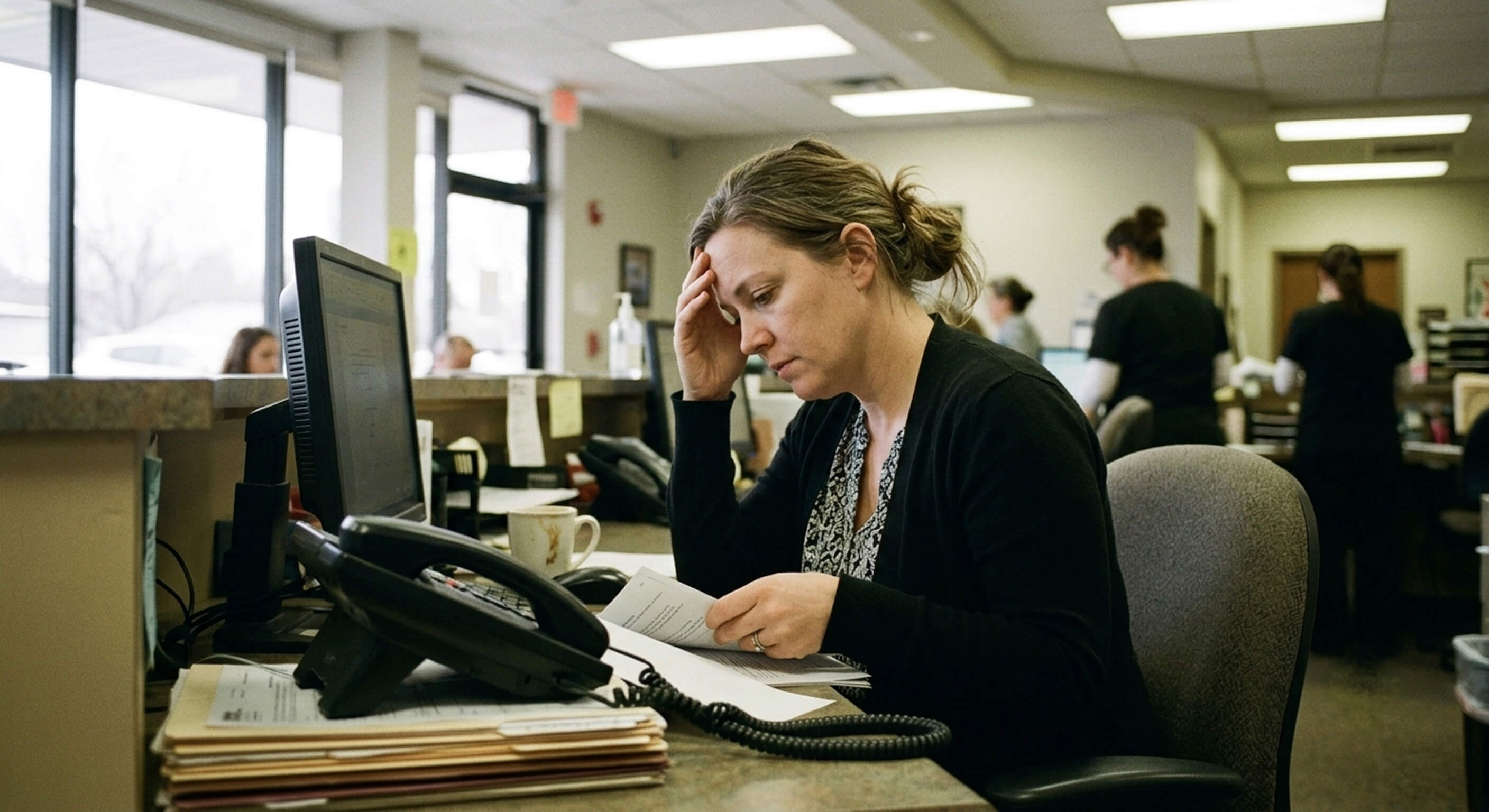
Here is the practical problem. “Transformational, evidence-based initiative” is abstract. Reviewers need something concrete. The strongest applications name a specific place where care is currently falling through, describe the structural fix, and state how the result will be measured.
For most rural health centers, three of those places are predictable.
The phone. More than 40 million people live in a rural primary care shortage area, and 92 percent of rural counties are designated primary care HPSAs. Federal projections suggest the rural physician supply will meet only 68 percent of demand by 2037. That shortage shows up first at the front desk, because call volume does not shrink to match available staff. Only about four in ten working-age rural adults can get a same-day or next-day primary care appointment. Roughly 38 percent of rural adults have used an emergency room for something a primary care practice could have handled. Calls that go unanswered during business hours mostly do not get answered at all. An unanswered call quietly becomes an access problem, and access is among the most consistently named priorities across state RHTP plans.
Chronic disease follow-up. Most health centers can identify which patients are overdue for an A1C check or a blood pressure recheck. Far fewer have a system that reliably reaches those patients before they turn up as a same-day walk-in with a complication. Outreach that depends on a staff member’s bandwidth on a given day is not a system. It is a hope.
The space between care settings. A patient discharged from the hospital, or referred to a specialist, generates paperwork and comparatively little follow-through unless someone tracks it end to end. Referral leakage and missed post-discharge follow-up are well-documented drivers of avoidable utilization in rural systems. They show up in the finances too, as Transitional Care Management revenue nobody billed and specialist visits that never happened.
None of these are staffing problems in the sense that hiring five more people would fix them, even if a health center could find five more people to hire in a labor market already short on clinicians. They are workflow problems. The work depends on a person remembering, calling, checking, and following up, every time, without fail.
That distinction is exactly the one RHTP reviewers are trying to make. A workflow that fails because a person got busy is a structural problem with a structural fix, and a structural fix is fundable.
Automating a task vs. redesigning a workflow
There is a meaningful difference between the two, and it maps closely onto the difference between a routine operating request and a transformational initiative.
A reminder text tells a patient they have an appointment. It does not rebook the one they just canceled, and it does not flag that the same patient has not been seen for their chronic condition in eight months.
A dashboard shows a care manager which patients are overdue. It does not call them, book them, or document the outreach in a form a grant program will accept as evidence of impact.
A redesigned workflow closes the loop without waiting for a person to notice it is open:
A call that comes in after hours gets answered by something other than voicemail, and routed correctly the first time.
A patient six weeks overdue for a diabetes visit gets a text, then a call, then a spot on the schedule, without anyone opening a spreadsheet.
A patient discharged on a Friday gets a follow-up call Monday, automatically, documented well enough to support a TCM claim.
A referral gets tracked until the appointment happens, not just until the fax confirms it went out.
Each of those has a number attached to it. Calls answered. Gaps closed. Discharges followed. Referrals completed. That is what makes a project writable into an application and defensible in a progress report.
Where HealthHelper fits
HealthHelper’s modules sit at this layer. Each is priced by what it does, so a health center can start with whichever workflow is breaking down hardest and have something concrete to point to when its state opens a relevant window.
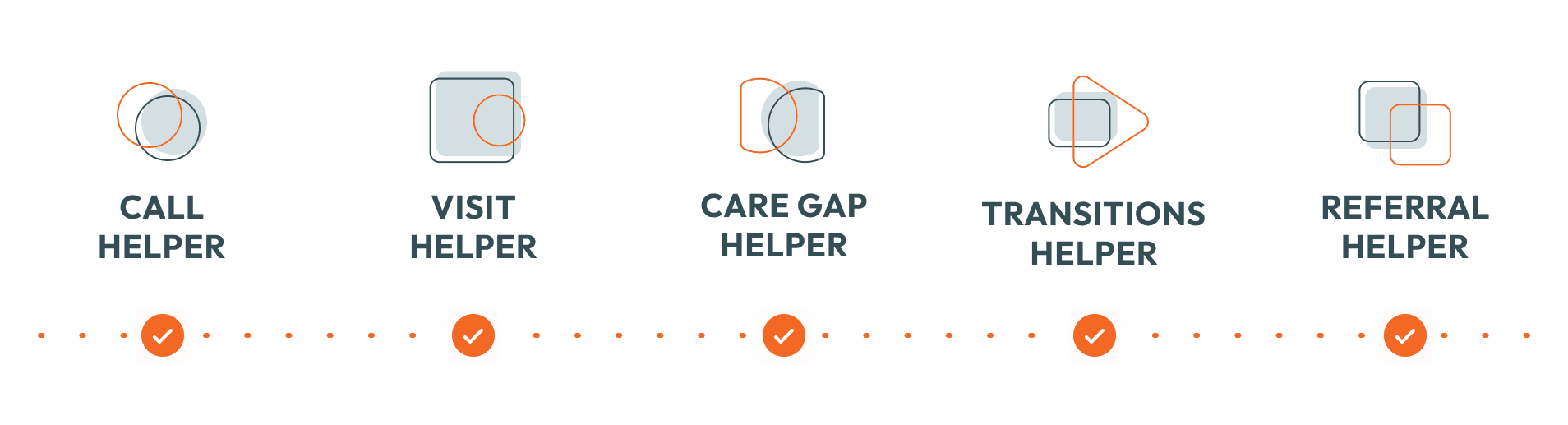
Where it breaks down | Module | What it produces |
Calls going unanswered, after-hours voicemail | Call Helper | Answered-call rate, after-hours capture |
Patients overdue for chronic disease visits | Visit Helper / Care Gap Helper | Gap closure rate, re-engagement volume |
Discharges with no follow-up | Transitions Helper | Follow-up completion, TCM-eligible encounters |
Referrals that never close | Referral Helper | Referral completion rate, leakage reduction |
What to have ready before a window opens
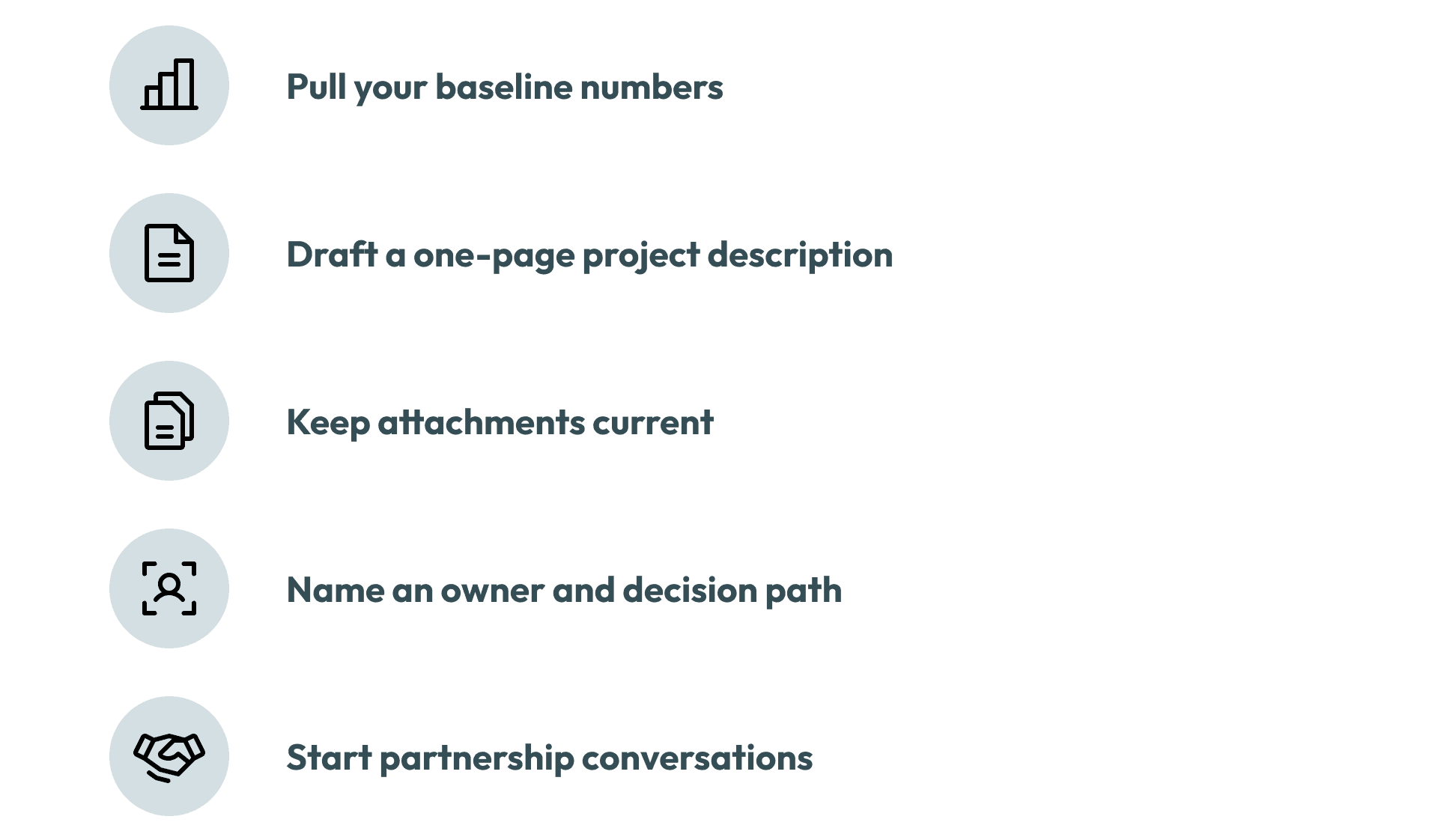
Short windows do not leave time to build an application from nothing. They leave time to assemble one from pieces you already have. The health centers that move fastest keep a standing file with five things in it.
A baseline number for each broken workflow. Not an estimate. An actual figure: how many inbound calls went unanswered last month, how many patients are currently overdue for a chronic disease visit, how many discharges in the last quarter got a documented follow-up within 14 days. These take a week to pull the first time and an hour to refresh after that. Without them you cannot describe a problem specifically or propose a measurable target.
A one-page project description you can adapt. State what breaks, what you would change structurally, what it costs, and what you would measure. Keep it flexible enough to reshape for a technology RFP, a care-coordination RFP, or an access initiative, because you will not know in advance which your state will post.
Your standard attachments, current. Audited financials, board roster, service area and patient demographics, HPSA designation, 501(c)(3) letter, UEI and SAM.gov registration. SAM registration in particular expires annually and takes weeks to renew. Check yours during a quiet stretch, not during an open window.
A named internal owner and a decision path. Who monitors the sources, who writes, who signs. If an application needs board approval, know in advance whether your board can approve by email between meetings. Health centers have missed windows on scheduling alone.
One or two partnership conversations already started. Many state programs favor regional collaboration between providers. A partnership formed in the week before a deadline reads that way to reviewers. A relationship you have already been building does not.
None of this requires a grant writer. It requires deciding in advance that RHTP is worth being ready for, and spending a few days on it now rather than a frantic week later.
A gut check before your next application
Before applying to a state RHTP program, or deciding how to deploy funding already awarded, five questions are worth answering honestly.
Do you know what your state currently has open, and what it plans to open next? If nobody can answer this today, that is the first gap to close.
Where are calls actually going unanswered, and what happens to those patients afterward?
Where does chronic disease follow-up depend on one specific person remembering to make one specific call?
Where does a referral or discharge sit for days before anyone checks on it?
Could you write a two-page proposal in a week if a fitting window opened tomorrow? Given how short some of these windows run, this is not hypothetical.
That last one is the real test. A health center that can point to exactly where its workflow breaks down, and describe a specific, measurable plan to fix the structure rather than fund more of the status quo, is in a stronger position for the application and for whatever rounds follow it.
The window is the constraint
RHTP puts real money behind rural transformation. But the money is not waiting for you. It moves through state processes on state timelines, and it goes to organizations that are ready when those processes open.
Which version of this program a given health center ends up in depends less on how much its state received and more on whether somebody is watching for the windows, and whether there is a scoped project ready to go when one opens.
If you are mapping your state’s RHTP programs against what is actually breaking down day to day, that work is worth doing before a window opens, not after.
Sources and where to check current status
Program mechanics and analysis:
• CMS, Rural Health Transformation (RHT) Program Overview
• CMS, $50 Billion in Awards to Strengthen Rural Health in All 50 States
• KFF Health News, States Race To Launch Rural Health Transformation Plans
• KFF, First-Year Rural Health Fund Awards by Rural Resident
• KFF Health News, Big Companies Position Themselves for Payday From $50B Federal Rural Health Fund
• UNC Cecil G. Sheps Center, RHTP Funding Amounts and State Policy Actions
• Commonwealth Fund, The State of Rural Primary Care in the United States